Wednesday, February 25, 2009


So maybe I'm not on the right page but I want to work on the theme of 'Corruption'. I will focus on American Born Chinese and Blankets for our readings in class. I think I'm going to do a multi -media project. I'll pull from outside sources such as V for Vendetta and other Graphic novels that deal with this theme. Maybe I should go with the idea of temptation. I think that would fit with everything better.

Monday, February 23, 2009

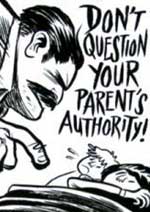
Respect my Authority!


My close reading on Blankets will be on the last three panels of page 80. Craig is at winter bible camp and he is seen reading the Bible. A boy in the bunk below him sees what he is doing and starts to make fun of him for it. In the second panel Craig lies and says he was only organizing his things and not actually reading the Bible. The third panel shows him putting his bible away and asking for God's forgiveness. I find these panels very interesting because in the Bible God always said to stand up for what you believe in and Craig doesn't do this, he pretends to hate it there as much as the rest of the group does to fit in better or avoid humiliation.  In the first panel the boy who is making fun of Craig looks very dopy and dumb well Craig just looks annoyed. In the second one they have more of the same expression. The third panel shows Craig's shame with the dark lines down his face.

Craig's relationship with his father is the most interesting to me. It reminds me of my relationship with my father, though maybe not to that extreme. There is a level of fear that plays an important role between them. I believe this fear calms down in the middle of the book however because Craig doesn't seem to be so afraid to ask if he could stay with his girlfriend for a few weeks. 

Wednesday, February 18, 2009

Shadrach, Meshach, and Abednego

This story always intrigued me as a child and when I read the names of the mice I knew who they were and what she was talking about instantaneously. But why was this story chosen? She needed a project and so she chose a story from the Bible but the writer's choice is much deeper than that. The story of Shadrach, Meshach, and Abendnego is a story about three brothers who work for a King. The boys are good hardworking men of God. They worship him above all and never give into temptation. Then one day the King asks them to bow down and worship a golden idol. They refuse and are punished by being thrown in the furnace, but they do not burn. A bright light emerges from the furnace and there can be seen four figures, the three boys and another figure. This figure is seen as Jesus Christ. This story is referenced to show Jeannette's own struggle with her sexuality. She refuses to give into the 'idol' of heterosexuality.

Monday, February 16, 2009

  • What do you believe? (or, perhaps like Morpheus in the Matrix, we might ask, "What is it that you choose to believe?" Will you take the red pill or the blue pill?)
  • I believe that as a population humans are dumb. We have devolved so much from our natural state that most of us can't stand a clear open space. In general I believe a lot of things to be true but I also am open to new ideas. I don't believe in a higher power but I am curious as to how it all started.
  • What or who has shaped your system of belief?
  • Working in this world and observing people for both art and writing classes. I've noticed little things like how people hold their hands to big things like the way people look when they lie. 
  • Think of a time when your belief system was challenged. How did you respond?
  • I did have a point where someone tried to convince me that God was real and that he was in my heart, they even tried to say a prayer for me and make me feel him but nothing happened I told her I was sorry and she said it was alright and that some day I would know the love of God. Maybe one day.
  • Consider "belief" in Oranges are Not the Only Fruit. What beliefs are firmly upheld? What beliefs are challenged or change? What self-revelations or "awakenings" occur in Winterson's modern-day Bildungsroman? Use quotes from the text as support.
  • When Jeanette was born then adopted in the book it was like the birth of Christ, and she much so followed his story thought the book. She is however gay and that conflicts with everything that she believes in and she struggles with this idea.
  • How are Jeanette's changing beliefs demonstrated symbolically or through foreshadowing within the pages of the novel?
  • The orange is an important part of the story and it seems to represent the stereotypical human. Heterosexual, normal. Her mother gives them to her in her times of need but when Melanie tries to give her one she refuses it.
  • What struggles still exist for Jeanette, even after she has "accepted" herself?
  • Her mother and friends wont talk to her and become repulsed by her when she is at the funeral. She keeps herself alone most of the time.

Tuesday, February 10, 2009

"What common conversation/theme is shared in each of the texts we have read in this unit? How do you respond to these themes as a reader? What passages or ideas were most relevant or powerful for you? Which were the most difficult for you? Explain your answers."

The common theme of all of the passages that we have read are becoming proud of who/what you are. In American Born Chinese both the monkey king and Jin learn how to accept who they are and that they are at their best when they are just being their selves. In The Bluest Eyes Pecola ends up going crazy and thinking that she has her beautiful eyes. From page 145 to page 150 in American Born Chinese the Monkey King learns that after five hundred years of being stuck under a pile of rocks he could have gotten out anytime he wanted if he just went back to being a monkey. On page 221 Jin finally understands everything that has been happening to him and learns to be just himself. This is the part of the story that brought all three parts together. In the Bluest Eye Morrison shows that when a person is determined and has a single mind set they can be pushed to the break as Pecola was.

Personally I believe that a person should be happy with who they are, and if they aren't they should change themselves to be happy. Even with this they should understand that they were made as they are for a reason, be it millions of years of evolution or some God type figure. They can accept themselves for who they are. But there are many people who aren't happy with themselves and they aren't doing anything to change it or they have a distorted view of the world. These people need to change to be happy. Both stories were good, I enjoyed the Graphic Novel more than the novel but that was a personal preference.

I believe that the passage that was the most relevant to me was from American Born Chinese. The section on Wong Lai-Tsao touched me the most. He wasn't a traditional monk in any sense but he did have a kind heart and helped the villagers. It reminded me of some Greek stories on the lesson of humility. He is rewarded for his kindness.

I didn't understand why Pecola's father needed to rape her twice. I know he was in the wrong mind set but it's his daughter for Christ sake.

Sorry it's late. I don't use the internet much outside of class.

Monday, February 2, 2009

Close Reading

This page is showing who Tze-Yo-Tzuh really is. He is the creator of the world and all that is, was, and will be. He proves how powerful he is by telling how he is everywhere. In the heavens and in the underworld. The pictures are very smoth in colors and Tze-Yo-Tzuh is depiceted as an old man with a cane showing how he is like an old shepard, guiding people and animals. There is humor in these panels as Tze-Yo-Tzuh whipes his hand of the Monkey King's leavings.